Performances of Elasto-FibroTest(®), a combination between FibroTest(®) and liver stiffness measurements for assessing the stage of liver fibrosis in patients with chronic hepatitis C.
Abstract
Background
FibroTest(®) (FT), and liver stiffness measurement (LSM) are the most validated techniques for the non-invasive assessment of fibrosis in patients with chronic hepatitis C (CHC). The combination between FibroTest(®) and LSM has never been assessed using methods assuming that biopsy is not a perfect gold standard.
Aim
The aim was to assess the performance of a new test the Elasto-FibroTest(®) (EFT) combining FibroTest(®) and LSM.
Methods
An integrated data base of 1289 patients with biopsy and 604 healthy volunteers was analyzed. EFT took into account the applicability of both tests, included two algorithms taking one for the diagnosis of advanced fibrosis (EFT-F2) and one for the diagnosis of cirrhosis (EFT-F4). Performances of EFTs were assessed by three methods: area under the ROC curve (AUROC), "Obuchowski method" (OBU) and 1 TAGS the "Latent class with random factor".
Results
For the diagnosis of advanced fibrosis EFT-F2 performances (specificity=0.99 and sensitivity=0.83) were not greater than the performances of FibroTest(®) alone (specificity=0.93 and sensitivity=0.99). For the diagnosis of cirrhosis, EFT-F4 performances were greater than those of FibroTest(®) alone, particularly for the sensitivity (0.88 vs. 0.74); when compared with LSM, EFT-F4 performances (specificity=0.99 and sensitivity=0.99) were also greater than those of LSM alone particularly because of its lower specificity (0.92).
Conclusion
For the diagnosis of cirrhosis the Elasto-FibroTest(®) has higher performances than FibroTest(®) or FibroScan(®) alone. No improvement in performance has been observed for the diagnosis of advanced fibrosis vs. FibroTest(®) alone.
Three Neglected STARD Criteria Reduce the Uncertainty of the Liver Fibrosis Biomarker FibroTest-T2D in Metabolic Dysfunction-Associated Steatotic Liver Disease (MASLD).
Clinical and genetic definition of serum bilirubin levels for the diagnosis of Gilbert syndrome and hypobilirubinemia.
Prospective direct comparison of non-invasive liver tests in outpatients with type 2 diabetes using intention-to-diagnose analysis.
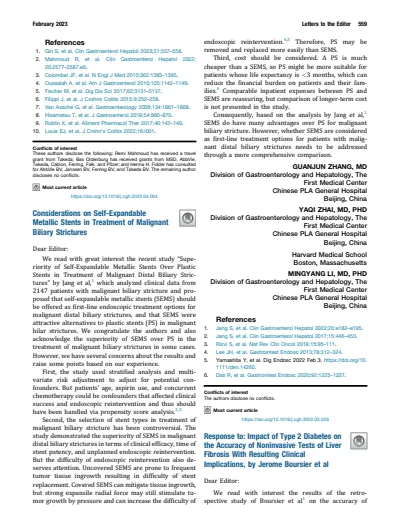
Response to: Impact of Type 2 Diabetes on the Accuracy of Noninvasive Tests of Liver Fibrosis With Resulting Clinical Implications, by Jerome Boursier et al.
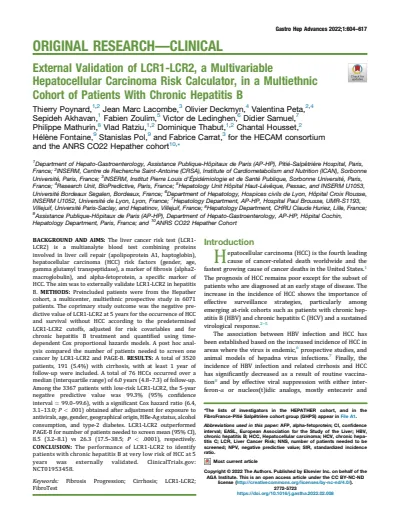
External Validation of LCR1-LCR2, a Multivariable Hepatocellular Carcinoma Risk Calculator, in a Multiethnic Cohort of Patients With Chronic Hepatitis B.
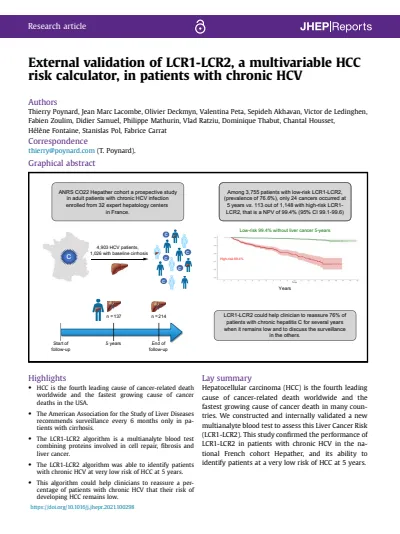
External validation of LCR1-LCR2, a multivariable HCC risk calculator, in patients with chronic HCV.
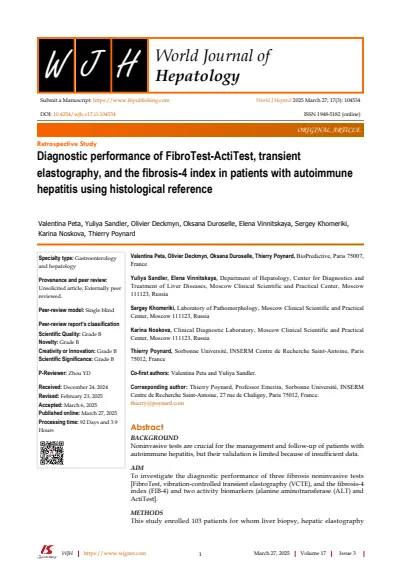
Diagnostic performance of FibroTest-ActiTest, transient elastography, and the fibrosis-4 index in patients with autoimmune hepatitis using histological reference.
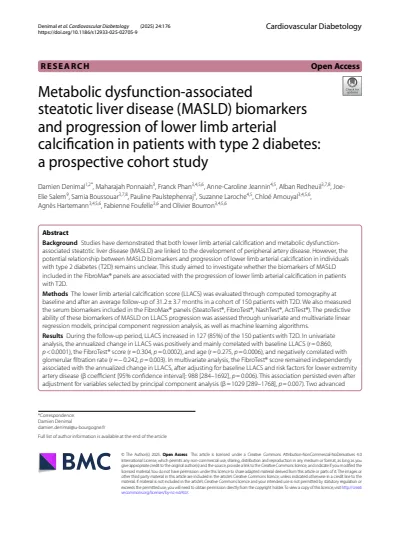
Metabolic dysfunction-associated steatotic liver disease (MASLD) biomarkers and progression of lower limb arterial calcification in patients with type 2 diabetes: a prospective cohort study.
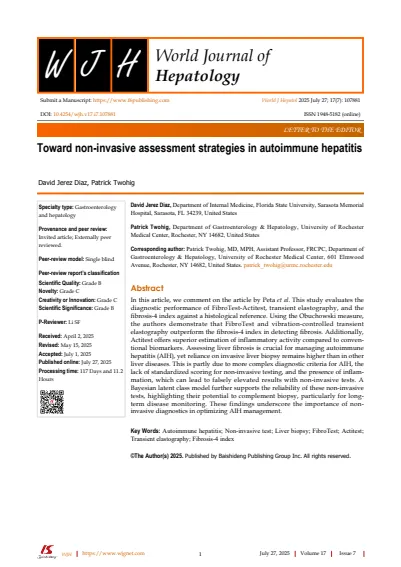
Toward non-invasive assessment strategies in autoimmune hepatitis.
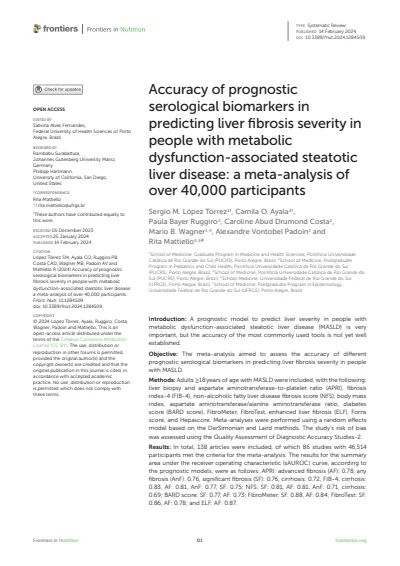
Accuracy of prognostic serological biomarkers in predicting liver fibrosis severity in people with metabolic dysfunction-associated steatotic liver disease: a meta-analysis of over 40,000 participants.
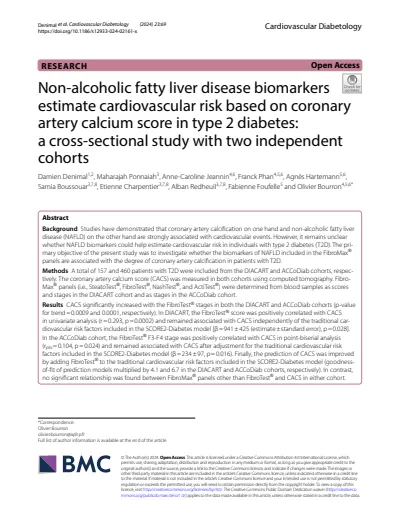
Non-alcoholic fatty liver disease biomarkers estimate cardiovascular risk based on coronary artery calcium score in type 2 diabetes: a cross-sectional study with two independent cohorts.