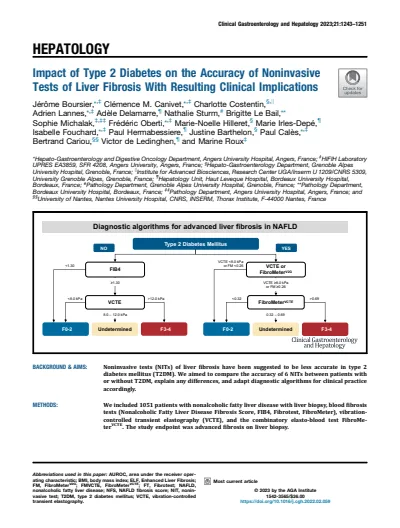
Prospective direct comparison of non-invasive liver tests in outpatients with type 2 diabetes using intention-to-diagnose analysis.
Abstract
Background
No prospective diagnostic studies have directly compared widespread non-invasive liver tests in patients with type 2 diabetes (T2D) using the intention-to-diagnose method for each of the three main histological features of metabolic dysfunction associated steatotic liver disease - namely fibrosis, metabolic dysfunction-associated steatohepatitis (MASH), and steatosis.
Aims
To compare the performance of nine tests using the intention-to-diagnose rather than the standard method, which would exclude non-evaluable participants METHODS: Biopsy was used as the reference with predetermined cut-offs, advanced fibrosis being the main endpoint. The Nash-FibroTest panel including FibroTest-T2D, SteatoTest-T2D and MashTest-T2D was optimised for type 2 diabetes. FibroTest-T2D was compared to vibration-controlled transient elastography stiffness (VCTE), two-dimensional shear-wave elastography stiffness (TD-SWE), and Fibrosis-4 blood test. NashTest-T2D was compared to aspartate aminotransferase. SteatoTest-T2D was compared to the controlled attenuation parameter and the hepatorenal gradient.
Results
Among 402 cases, non-evaluable tests were 6.7% for VCTE, 4.0% for hepatorenal gradient, 3.2% for controlled attenuation parameter, 1.5% for TD-SWE, 1.2% for NashTest-T2D, and 0.02% for Fibrosis-4, aspartate aminotransferase and SteatoTest-T2D. The VCTE AUROC for advanced fibrosis was over-estimated by 6% (0.83 [95% CI: 0.78-0.87]) by standard analysis compared to intention-to-diagnose (0.77 [0.72-0.81] p = 0.008). The AUROCs for advanced fibrosis did not differ significantly in intention-to-diagnose between FibroTest-T2D (0.77; 95% CI: 0.73-0.82), VCTE (0.77; 95% CI: 0.72-0.81) and TD-SWE(0.78; 0.74-0.83) but were all higher than the Fibrosis-4 score (0.70; 95% CI all differences ≥7%; p ≤ 0.03). For MASH, MashTest-T2D had a higher AUROC (0.76; 95% CI: 0.70-0.80) than aspartate aminotransferase (0.72; 95% CI: 0.66-0.77; p = 0.035). For steatosis, AUROCs did not differ significantly between SteatoTest-T2D, controlled attenuation parameter and hepatorenal gradient.
Conclusions
In intention-to-diagnose analysis, FibroTest-T2D, TD-SWE and VCTE performed similarly for staging fibrosis, and out-performed Fibrosis-4 in outpatients with type 2 diabetes. The standard analysis over-estimated VCTE performance.
Clinicaltrial
gov: NCT03634098.
Keywords — author-chosen EPoS, NASH, NashFibroTest, advanced fibrosis, applicability, effectiveness, reliability
Three Neglected STARD Criteria Reduce the Uncertainty of the Liver Fibrosis Biomarker FibroTest-T2D in Metabolic Dysfunction-Associated Steatotic Liver Disease (MASLD).
Clinical and genetic definition of serum bilirubin levels for the diagnosis of Gilbert syndrome and hypobilirubinemia.
Response to: Impact of Type 2 Diabetes on the Accuracy of Noninvasive Tests of Liver Fibrosis With Resulting Clinical Implications, by Jerome Boursier et al.
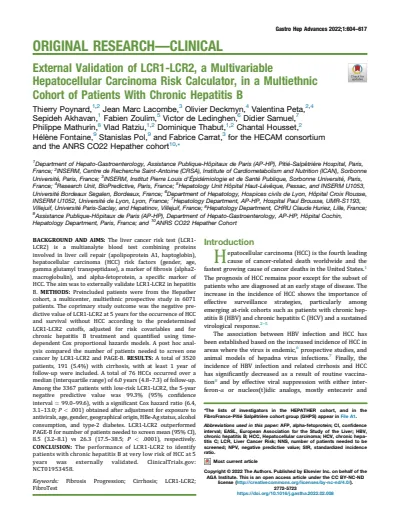
External Validation of LCR1-LCR2, a Multivariable Hepatocellular Carcinoma Risk Calculator, in a Multiethnic Cohort of Patients With Chronic Hepatitis B.
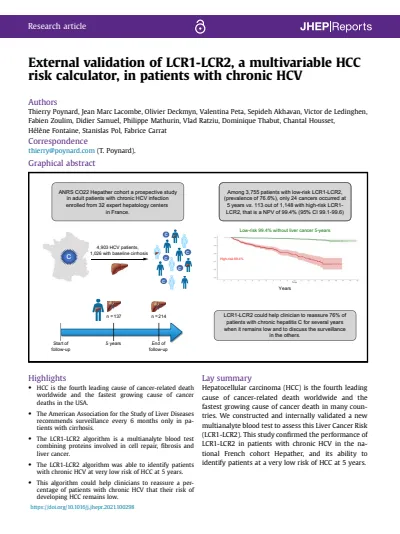
External validation of LCR1-LCR2, a multivariable HCC risk calculator, in patients with chronic HCV.

Prospective external validation of a new non-invasive test for the diagnosis of non-alcoholic steatohepatitis in patients with type 2 diabetes.
Metabolic dysfunction-associated steatotic liver disease (MASLD) biomarkers and progression of lower limb arterial calcification in patients with type 2 diabetes: a prospective cohort study.
Three Neglected STARD Criteria Reduce the Uncertainty of the Liver Fibrosis Biomarker FibroTest-T2D in Metabolic Dysfunction-Associated Steatotic Liver Disease (MASLD).
Accuracy of prognostic serological biomarkers in predicting liver fibrosis severity in people with metabolic dysfunction-associated steatotic liver disease: a meta-analysis of over 40,000 participants.
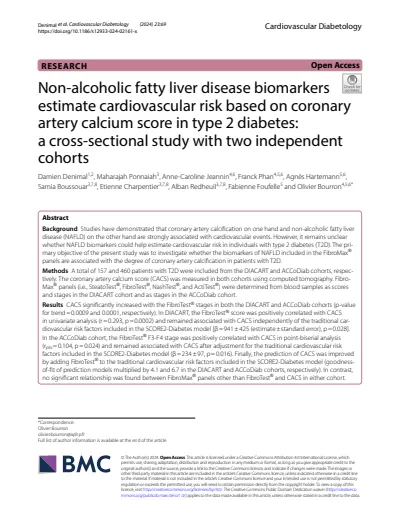
Non-alcoholic fatty liver disease biomarkers estimate cardiovascular risk based on coronary artery calcium score in type 2 diabetes: a cross-sectional study with two independent cohorts.
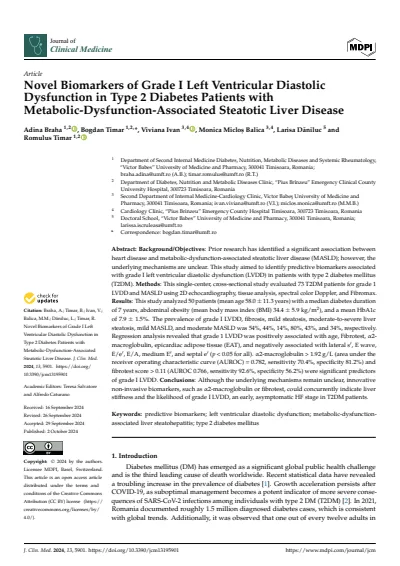
Novel Biomarkers of Grade I Left Ventricular Diastolic Dysfunction in Type 2 Diabetes Patients with Metabolic-Dysfunction-Associated Steatotic Liver Disease.