Diagnostic performance of FibroTest-ActiTest, transient elastography, and the fibrosis-4 index in patients with autoimmune hepatitis using histological reference.
Abstract
Background
Noninvasive tests are crucial for the management and follow-up of patients with autoimmune hepatitis, but their validation is limited because of insufficient data.
Aim
To investigate the diagnostic performance of three fibrosis noninvasive tests [FibroTest, vibration-controlled transient elastography (VCTE), and the fibrosis-4 index (FIB-4) and two activity biomarkers (alanine aminotransferase (ALT) and ActiTest].
Methods
This study enrolled 103 patients for whom liver biopsy, hepatic elastography results, and laboratory markers were available. Diagnostic performance was assessed with receiver operating characteristic (ROC) curves, the Obuchowski measure (OM), and the Bayesian latent class model.
Results
FibroTest and VCTE outperformed FIB-4 in cases of significant fibrosis (≥ F2), with areas under the ROC curve of 0.83 [95% confidence interval (CI): 0.73-0.90], 0.86 (95%CI: 0.77-0.92), and 0.71 (95%CI: 0.60-0.80), respectively. The mean (standard error) OM values were 0.92 (0.01), 0.93 (0.01), and 0.88 (0.02) for FibroTest, VCTE, and FIB-4, respectively; FibroTest and VCTE performed comparably, and both were superior to FIB-4 (P = 0.03 and P = 0.005). The areas under the ROC curve values for activity biomarkers were 0.86 (95%CI: 0.76-0.92) for ActiTest and 0.84 (95%CI: 0.73-0.90) for ALT (P = 0.06). The OM values for ActiTest and ALT were 0.92 (0.02) and 0.90 (0.02), respectively (P = 0.005).
Conclusion
FibroTest and VCTE outperformed FIB-4 according to the OM. FibroTest-ActiTest facilitated the evaluation of both fibrosis and activity.
Keywords — author-chosen ActiTest, Autoimmune hepatitis, FibroSure, FibroTest, Fibrosis, Fibrosis-4 index, Vibration-controlled transient elastography

Metabolic dysfunction-associated steatotic liver disease (MASLD) biomarkers and progression of lower limb arterial calcification in patients with type 2 diabetes: a prospective cohort study.
Toward non-invasive assessment strategies in autoimmune hepatitis.
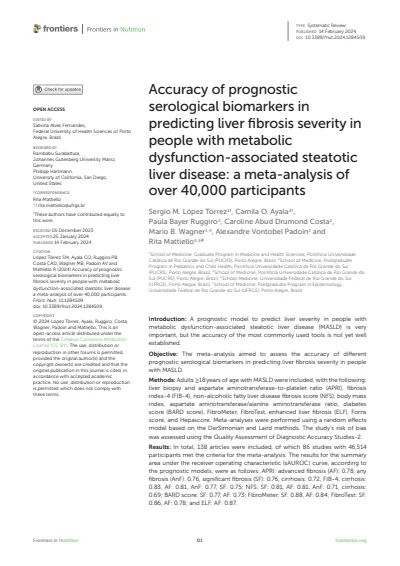
Accuracy of prognostic serological biomarkers in predicting liver fibrosis severity in people with metabolic dysfunction-associated steatotic liver disease: a meta-analysis of over 40,000 participants.
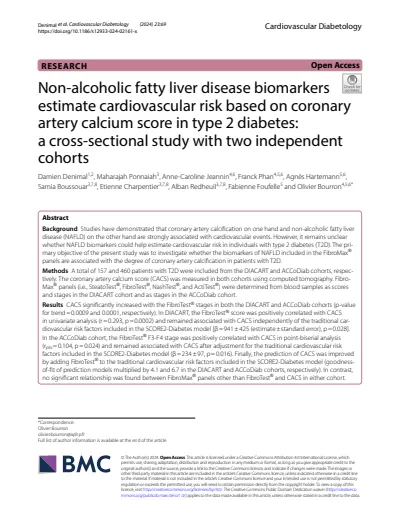
Non-alcoholic fatty liver disease biomarkers estimate cardiovascular risk based on coronary artery calcium score in type 2 diabetes: a cross-sectional study with two independent cohorts.
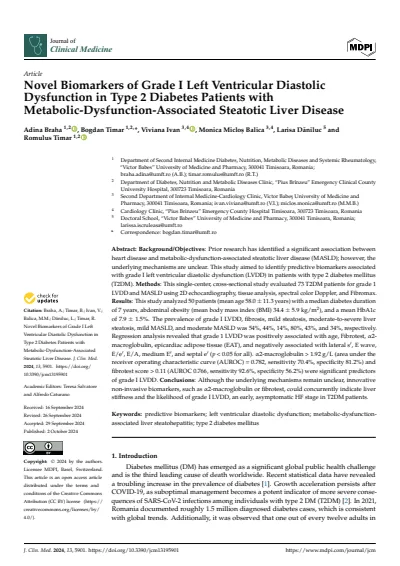
Novel Biomarkers of Grade I Left Ventricular Diastolic Dysfunction in Type 2 Diabetes Patients with Metabolic-Dysfunction-Associated Steatotic Liver Disease.