Use of Non-invasive Testing to Stage Liver Fibrosis in Patients with HIV.
Abstract
Patients with HIV have a proclivity to develop liver fibrosis, especially when associated with other conditions such as HCV, HBV, and NAFLD. Identifying HIV-infected patients with significant fibrosis or cirrhosis plays an important role in clinical and therapeutic decision-making. Liver biopsy is currently considered as the gold standard for fibrosis assessment but carries many shortcomings (cost, invasiveness, complications, false negative rate of 20 %). Multiple non-invasive methods of liver fibrosis assessment have been developed, but not all have been studied in HIV-infected individuals. Non-invasive liver fibrosis tools include both serologic-based testing scores (rely on direct and/or indirect markers) such as APRI, FIB4, FibroTest, FibroSpect II, HepaScore, or imaging-based methods such as vibration controlled liver elastography. There is validated data to support the use of non-invasive modalities of fibrosis assessment in HIV-HCV co-infected individuals for the exclusion of cirrhosis, but may be poorly reliable or not enough data exists for the assessment of other co-morbid disease processes.
Keywords — author-chosen Biomarkers, HIV non-alcoholic fatty liver disease, HIV-hepatitis B, HIV-hepatitis C, Liver fibrosis, Transient elastography
Diagnostic performance of FibroTest-ActiTest, transient elastography, and the fibrosis-4 index in patients with autoimmune hepatitis using histological reference.
Metabolic dysfunction-associated steatotic liver disease (MASLD) biomarkers and progression of lower limb arterial calcification in patients with type 2 diabetes: a prospective cohort study.
Toward non-invasive assessment strategies in autoimmune hepatitis.
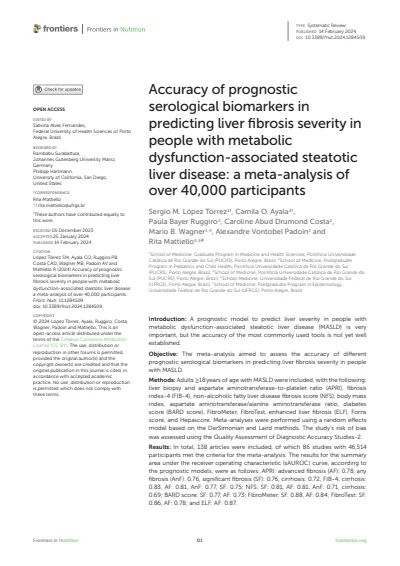
Accuracy of prognostic serological biomarkers in predicting liver fibrosis severity in people with metabolic dysfunction-associated steatotic liver disease: a meta-analysis of over 40,000 participants.
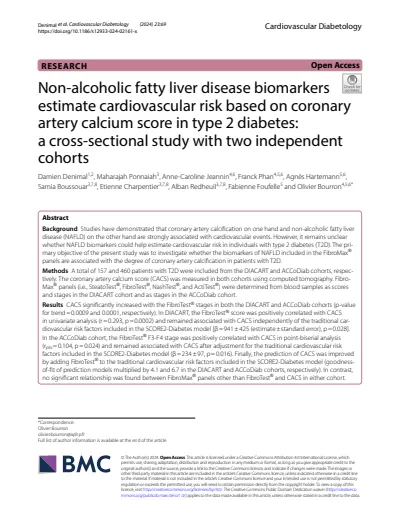
Non-alcoholic fatty liver disease biomarkers estimate cardiovascular risk based on coronary artery calcium score in type 2 diabetes: a cross-sectional study with two independent cohorts.