Predicting significant fibrosis in hepatitis C patients in Luxembourg using serological markers.
Abstract
Objective
The aim of our study was to assess the diagnostic performance of various serological markers and scores for predicting significant fibrosis retrospectively in a population of patients referring to our hospital for liver biopsy and chronic hepatitis C.
Materials And Methods
Stored serum obtained from 186 patients were tested for a number of biological markers putatively associated with liver fibrosis. Fibrotest and Forns scores were compared with liver fibrosis pathology scored according to the METAVIR system by multiple logistic regression.
Results
The prevalence of significant fibrosis was 44%. Aspartate amino transferase (AST) and gamma-glutamyltransferase (GGT) were most correlated with METAVIR staging, followed by platelet counts and alpha2-macroglobulin. The negative predictive value was 77% and 83% and the positive predictive value was 100% and 84% for the Forns score and the Fibrotest, respectively. In multivariate analysis AST, GGT and alpha2-macroglobulin had independent predictive power.
Conclusions
The accuracy of serological markers in predicting significant fibrosis is limited, because approximately two thirds of patients lie into an indeterminate "grey zone". Serological markers might be useful for patients reluctant to undergo liver biopsy but current predictive scoring systems are too inaccurate to replace biopsies in a routine manner.
Diagnostic performance of FibroTest-ActiTest, transient elastography, and the fibrosis-4 index in patients with autoimmune hepatitis using histological reference.
Metabolic dysfunction-associated steatotic liver disease (MASLD) biomarkers and progression of lower limb arterial calcification in patients with type 2 diabetes: a prospective cohort study.
Toward non-invasive assessment strategies in autoimmune hepatitis.
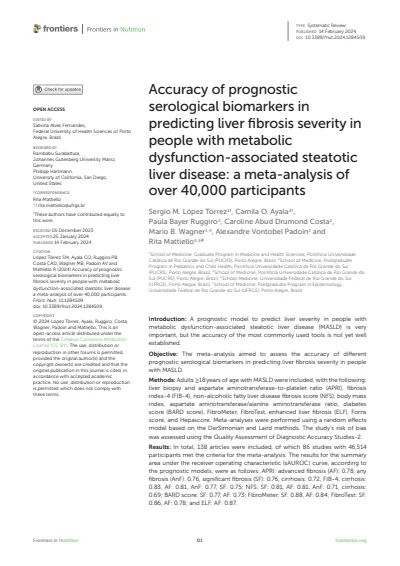
Accuracy of prognostic serological biomarkers in predicting liver fibrosis severity in people with metabolic dysfunction-associated steatotic liver disease: a meta-analysis of over 40,000 participants.
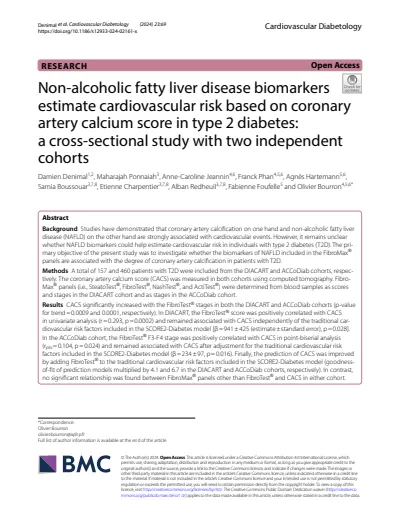
Non-alcoholic fatty liver disease biomarkers estimate cardiovascular risk based on coronary artery calcium score in type 2 diabetes: a cross-sectional study with two independent cohorts.